Artificial intelligence is reshaping how we create content, but with this innovation comes responsibility. Understanding AI content ethics in 2026 is essential for maintaining trust, ensuring accuracy, and avoiding legal or reputational risks.
From transparency to bias and copyright concerns, ethical AI use is now a core part of content strategy, not an afterthought.
What Is AI Content Ethics?
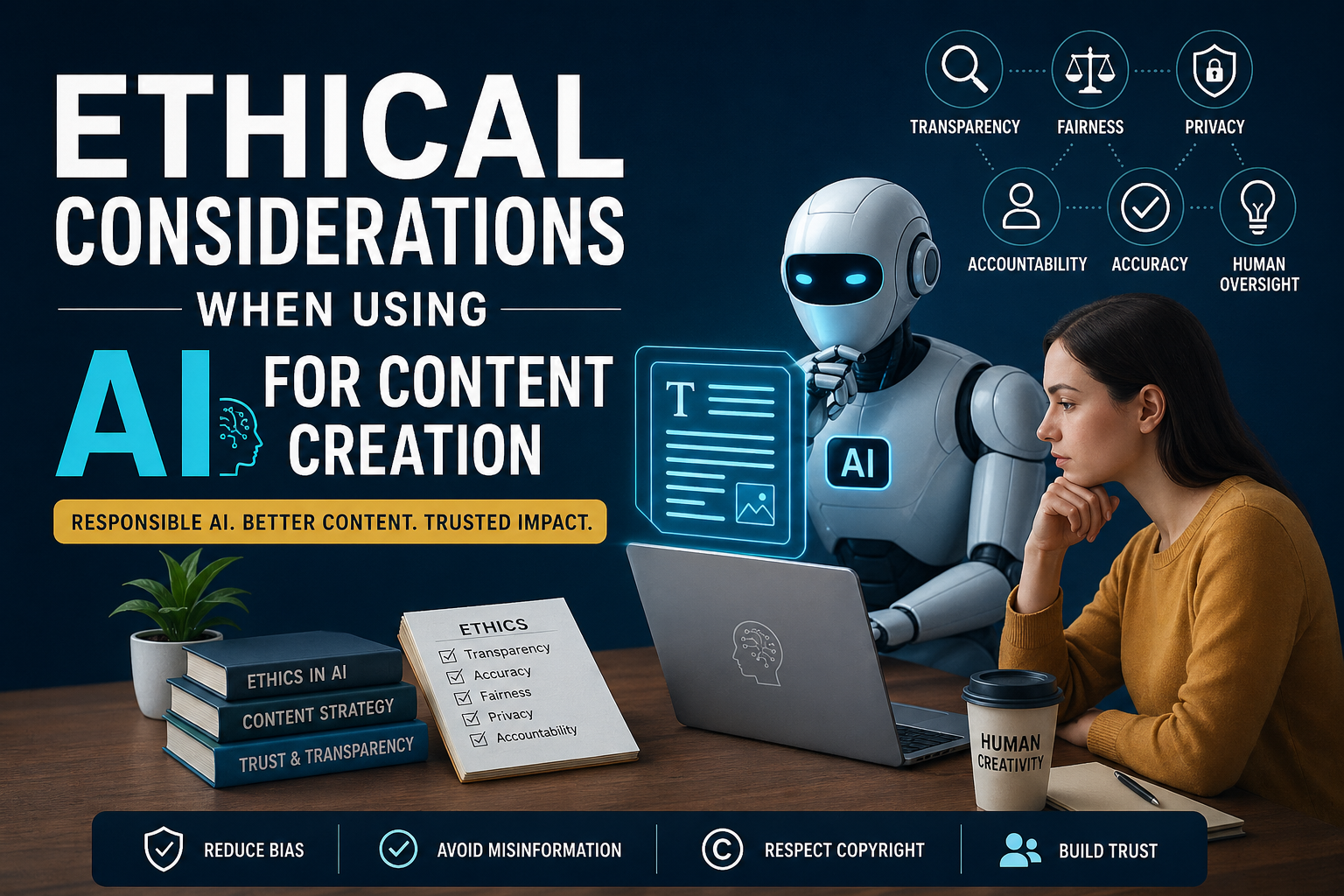
AI content ethics refers to the responsible use of artificial intelligence in creating digital content. It includes principles such as:
- Transparency
- Accuracy
- Fairness
- Accountability
- Respect for intellectual property
As AI tools become more advanced, ethical considerations are becoming stricter and more important.
Why AI Content Ethics Matters in 2026
The rapid growth of AI-generated content has led to:
- Increased misinformation risks
- Search engine scrutiny
- Audience trust issues
- Regulatory attention
Search engines now prioritize helpful, trustworthy, human-reviewed content, making ethical AI use a ranking factor.
1. Transparency and Disclosure
One of the biggest ethical questions is whether you should disclose AI generated content.
Best Practice:
Always inform readers when AI is used, especially in:
- News articles
- Product reviews
- Educational content
Example:
“This article was created with AI assistance and reviewed by a human editor.”
2. Avoiding AI Generated Misinformation
AI tools can generate incorrect or misleading information.
Risks:
- False facts
- Fabricated sources
- Outdated data
Solution:
- Fact check every claim
- Use trusted sources
- Add human verification
Accuracy is critical for SEO and credibility.
3. Bias in AI Content
AI systems can unintentionally reflect biases from training data.
Examples:
- Gender bias
- Cultural stereotypes
- Political skew
Ethical Tip:
Always review and edit AI outputs to ensure fairness and inclusivity.
4. Originality and Plagiarism
AI generated content must still be original.
Risks:
- Duplicate content
- SEO penalties
- Copyright issues
Best Practices:
- Use plagiarism checkers
- Rewrite and personalize content
- Add unique insights
5. Copyright and Ownership in AI Content
Who owns AI generated content is still a legal gray area in 2026.
Key Points:
- Fully AI generated content may not be copyright-protected
- Human input strengthens ownership claims
Recommendation:
Always edit AI content and add human creativity.
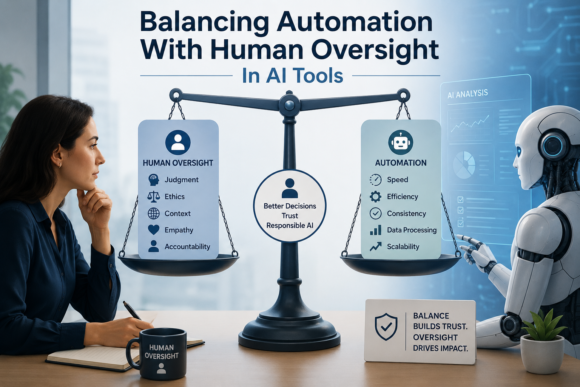
6. Human Oversight Is Essential
AI should assist, not replace humans.
Why It Matters:
- Ensures quality
- Maintains brand voice
- Prevents ethical issues
Think of AI as a co pilot, not the driver.
7. Data Privacy and Security
Using AI tools may involve sharing sensitive data.
Risks:
- Data leaks
- Misuse of information
Best Practices:
- Avoid entering confidential data
- Use trusted AI platforms
- Review privacy policies
8. Over Reliance on AI
Too much automation can reduce creativity and originality.
Warning Signs:
- Generic content
- Lack of unique voice
- Repetitive ideas
Solution:
Blend AI efficiency with human creativity.
Ethical Guidelines for AI Content Creation
Follow these principles to stay compliant and competitive:
- Be transparent about AI use
- Fact-check all content
- Ensure originality
- Monitor bias
- Protect user data
- Maintain human oversight
The Future of AI Content Ethics
In 2026 and beyond, expect:
- AI content regulations
- Mandatory disclosures
- AI watermarking systems
- Improved detection tools
Ethical AI use will become a standard requirement, not a competitive advantage.
Conclusion
AI is transforming content creation, but ethical responsibility must guide its use. By focusing on transparency, accuracy, and human oversight, you can create content that is not only efficient but also trustworthy and future proof.

This article was created with AI assistance and reviewed by a human editor.





This is an incredibly timely breakdown for 2026. As we move into an era of stricter AI regulations and the EU AI Act, the focus on “accountability” over just “efficiency” is spot on.
In my experience, the biggest risk for creators right now isn’t the AI itself, but the “set it and forget it” mentality. In a world flooded with synthetic content, maintaining a “Human-in-the-loop” model is the only way to protect brand authority and ensure ethical integrity. I’ve found that using AI for the heavy lifting of research—while keeping 100% control over the final voice and verification—is where the real value lies.
Quick question: With the new disclosure guidelines coming into play this year, do you think we will reach a point where “Human-Verified” labels become as common and essential as SSL certificates for building reader trust?
That’s a really sharp way of framing it, and you’re right to connect this directly to where regulation is heading.
Short answer: yes, “Human-Verified” (or something very close to it) is likely to become common, but not in the exact way SSL certificates did. It’ll emerge more as a trust signal layer on top of mandatory disclosure, not a universal technical standard, at least not immediately.
I really enjoyed this perspective. AI isn’t just about speed, it’s about responsibility too. I think a lot of people overlook things like accuracy, bias, and transparency when creating content. When used intentionally, AI can support creativity, but it shouldn’t replace the human voice behind it.
Do you think most creators are thinking about ethics yet, or are they still focused mainly on output?
That’s a sharp observation, and honestly, most creators are still prioritizing output over ethics right now.
We’re in a phase where AI feels like a competitive advantage, so the focus is often on speed, volume, and staying relevant. That pressure tends to push questions like accuracy, bias, and transparency into the background. Not because creators don’t care, but because the incentives (algorithms, monetization, visibility) reward more content, not necessarily better or more responsible content.
That said, there’s a shift starting.
More experienced creators, and especially those building long-term brands, are beginning to realize that trust is an asset. If audiences start questioning whether content is misleading, generic, or overly automated, it erodes credibility fast. And once that trust is gone, it’s hard to rebuild.
So right now it’s a bit of a split:
Early-stage or growth-focused creators – mostly focused on output and efficiency
Established or brand-focused creators -increasingly thinking about ethics, transparency, and originality
Long-term, ethics will likely become a differentiator. The creators who are open about how they use AI, fact-check their work, and keep a clear human perspective in their content will stand out more as the space gets saturated.
In a way, we’re moving from “AI as a shortcut” to “AI as a tool you’re accountable for.”
I’m curious, when you think about ethical use, which concern stands out most to you: accuracy, bias, or transparency?
I’ve been using AI tools in my own content creation, and one thing I’ve realized is how easy it is to rely on them too much if you’re not careful. It saves time, but without adding your own voice or checking accuracy, the content can feel generic or even misleading. I like that you focused on responsibility and best practices, it’s something a lot of beginners overlook when they’re just trying to produce more content quickly.
How do you see search engines evolving when it comes to AI-generated content? Do you think they’ll prioritize human-edited content more heavily over time?
That’s a really sharp observation, and I agree, the convenience of AI can quietly turn into over-reliance if you’re not intentional about how you use it. The difference between generic output and meaningful content almost always comes down to how much human judgment, editing, and perspective is layered on top.
On search engines, I think we’re already seeing a shift toward quality signals over origin. It’s less about “was this written by AI or a human?” and more about:
– Is it accurate?
– Does it demonstrate real experience or insight?
– Is it actually useful to the reader?
That said, human-edited content definitely has an advantage, because it naturally brings originality, context, and credibility. Search systems are getting better at detecting patterns of low-value, mass-produced content, so purely AI-generated material without oversight will likely struggle more over time.
I don’t think AI content will be penalized outright, but unreviewed or uninspired content probably will be. The winning approach is what you hinted at: using AI as a tool, not a replacement, and ensuring there’s a clear human voice and accountability behind what’s published.
Curious to see how others are balancing this, there’s definitely a learning curve for everyone right now.